
The Portraitist

In 2024, the Gulgee Museum opened in Karachi, and its curator Amin Gulgee asked me to contribute an essay to the Handbook. Here in its original format is that essay (it was slightly edited for the Handbook). It is called The Portraitist, and it’s about the great artist Gulgee’s portrait work. I thought it would be a nice tribute to Gulgee and to His Highness Prince Karim Aga Khan, who Gulgee memorialized in a timeless mosaic portrait of lapis lazuli, on the occasion of the current Ismaili leader, Prince Rahim Aga Khan, currently on his first visit/didar to his people in Gilgit Baltistan.
.
The Portraitist
Ismail Gulgee, famed for his Islamic calligraphies, sculptures and abstract paintings, made a name for himself in the 1950s and 1960s as a gifted portraitist. Commissioned by governments and kings, Gulgee created intricate, ornate mosaics in lapis lazuli, a deep-blue, metamorphic rock mined from Afghanistan. This sapphire-blue stone derives its color from lazurite, its gold flecks from iron pyrite, and other minerals like calcite, mica, titanate and zircon. It has been used for jewelry, makeup, sculptures and other ornamental objects since at least 3000 BC.
Gulgee’s is a ground-breaking style of portraiture, using a rock found predominantly at the crossroads of Central and South Asia, capturing the faces of Muslim leaders and monarchs, from the hands and eyes of a Pakistani artistic genius. His mosacis are primordially, quintessentially Eastern in origin, following the tradition of parchinkari (pietra dura) as seen in the Taj Mahal, yet they transcend any cultural geography. To understand the deeper significance of Gulgee’s portraits, we must go back to the origins of Gulgee as an artist, inextricably tied with the origins and destiny of Pakistan as a nation.
Ismail Gulgee was born in Peshawar in 1926. He trained as an engineer, first at Aligarh University, then Columbia and Harvard. During his days as an engineering student at Columbia, Gulgee studied Western classical painting and art on his own time and applied its principles and techniques to his work. Just as he was about to undertake PhD studies at Harvard, he was summoned to join an engineering firm in Stockholm which advised the new state of Pakistan on the construction of the Warsak Dam and other dams in East Pakistan.
At the same time, Gulgee drew and painted everything he could, holding a solo exhibition in Warsak, near the construction site of the dam. Gulgee’s official career as a portrait artist began when the Afghan government commissioned him to paint King Zahir Shah in 1955. These portraits, one in oil and one a mosaic using pieces of onyx, pleased the King so much he invited Gulgee to stay nine months in Kabul in 1958, where the artist produced 151 portraits of the entire Afghan Royal Family.
In 1958, President Iskandar Mirza abrogated the Constitution after a ten-year period of political instability marked by infighting and struggle since Mohammed Ali Jinnah’s death in 1948. Mirza appointed Ayub Khan chief martial law administrator, but the General declared himself President and exiled Mirza to London. Ayub’s aspirations for Pakistan were grand: economic prosperity and for the nation to be recognized as one of the important, up-and-coming Muslim nations of the world.
Ayub, who understood the principles of soft power and cultural diplomacy, changed Gulgee’s destiny by commissioning him to paint formal portraits. Gulgee painted Pakistani leaders – the founder of Pakistan, Muhammed Ali Jinnah, Ayub of course, but also leaders of countries friendly to Pakistan, or whose friendship Ayub desired to court: the kings and princes of Saudi Arabia, Zhou Enlai of China, the Shah of Iran and his wife Farah Pahlavi, King Hussein of Jordan. It was a pantheon of the significant Muslim world leaders over the last half of the 20th century, and Ayub imagined himself as part of it; Gulgee put that dream on canvas for him, and for perpetuity.
The 60s and 70s were tumultuous times for the Muslim world: the Muslim World League established by Saudi Arabia in 1962 aimed to unify Muslim nations and spread Islam throughout the world. Various alliances between Arab states contributed to the popularity of the Pan-Arabist movement, until the Six Day War when Israel defeated the Arab states in 1967. Rivalry between Saudi Arabia and Iran, the emergence of political Islamist movements, the shift from Pan-Arabism to individual Arab nationalist movements: through it all, Ayub was determined to show that Pakistan was still an important part of the Islamic solidarity movement. {This is all very interesting. I like the way you put Ayub in a global context.]
Although Ayub had hardly seized power through democratic means, he was a graduate of Sandhurst and the commander of a regiment in World IIera Burma and a battalion in India. This meant that other WW II generals-turned-leaders such as Charles de Gaulle and Dwight D. Eisenhower felt a strong affinity to Khan. They invited him and his entourage for state visits in the 1960s to France and the United States. Gulgee accompanied him on these trips, witnessed the arrival of countless foreign delegations to Pakistan, and drew some of the most memorable sketches of his career. Some are formal portraits, others tableaux of history as it unfolded before Gulgee’s eyes. Official photographers captured the official moments that appeared in newspapers both in Pakistan and abroad. But Gulgee’s sketches illustrated what power looked like when it was embodied in human form and in action, not posed for a formal photo op.
Take, for example, Charles de Gaulle, in a suit, not a military uniform, standing tall with his eyes closed, chin raised, hands clasped. Or the up-and-coming Foreign Minister Zulfikar Ali Bhutto in a crumpled suit, sitting at his desk with files laid out in front of him (and a clever mini-portrait of Quaid-e-Azam behind him). Muammar Gadafi of Libya, delivering a speech, his hands up in the air and a smile on his handsome face. Four Saudi princes standing with swords raised, enjoying a moment of ceremonial revelry. A group of dignitaries arriving to lay a wreath on the tomb of Quaid-e-Azam, naval soldiers struggling with the heaviness of the flowers.
In the 1970s, Gulgee began to harness the thousands of shades and colors present in lapis lazuli to create his most arresting portraits. His subjects range from Prince Sultan Muhammed Shah Aga Khan (III), Prince Ali Khan and Prince Sadruddin Aga Khan (IV) – spiritual leaders of the Ismaili Muslims -- to Prince Abdullah bin Faisal, Princess Husna bint Khalid, King Faisal and King Khalid, all of Saudi Arabia. As well as lapis, many of these portraits feature semi-precious gemstones: jade, agate, rather than diamonds or rubies, as has been claimed. King Faisal’s portrait makes use of $20,000 worth of lapis lazuli, ranging in color from white to blue-green, indigo to black.
Gulgee used pencil on pastel paper to sketch the faces of Rajiv Gandhi, George HW Bush, Richard Nixon, President Evren of Turkiye, Zhou En Lai, Zulfikar Ali Bhutto. The Saudi royal family members appear in these series, as well as Ayub Khan, These portraits imbue in their subjects a sense of age and wisdom, intellect, a certain knowing of their destiny, but the man stripped back, the black and white of the pencil sketches emphasizing their balding foreheads, the wrinkles around their eyes. Whatever these men had done to come to power, Gulgee did not judge. You could imagine them tired at the end of a long day, or as grandfathers who didn’t quite have the energy to keep up with their boisterous grandchildren.
The years passed, but the faces changed. More portraits of Zulfikar Ali Bhutto, now Prime Minister, no more portraits of the Shah of Iran, deposed in the Iranian Revolution. And a new face: General Zia, the dictator who deposed Bhutto, imposed eleven years of martial law, and served as America’s ally in the Soviet-Afghan War during the 1980s. There are many portraits of Zia, in fact, some with Ronald Reagan, at a time when the United States wooed Pakistan with every benefit and facility it could offer in return for Pakistan’s support. Others show Zia on his own, standing at a podium and delivering a speech, or sitting on the floor, legs crossed, head bowed, in a pose of humility.
With those early commissioned mosaics, Gulgee also created a mural for the King Faisal Medical City, inspired by the Black Stone of the Ka’aba. To portray the idea that both sickness and healing comes from God, he added this line from the Quran to the mural: “And He alone heals me when I am sick.” At the 1984 inauguration of the Aga Khan University Hospital in Karachi, Gulgee painted a Quranic verse in calligraphy on a six-foot-large hard board disc as the verse was recited live at the inauguration ceremony. In the 1980s, he created a series of horse- and polo-themed mosaics in lapis, the most magnificent of which is “Horses”: two stallions tossing their heads, hooves raised, manes and tails flowing. It is a moment of sheer might in animal form, paying tribute to the importance of horses in Islamic civilization.
In European courts, kings and emperors ruled by Divine Right, the belief that God himself had legitimized their reign. The Muslim leaders and monarchs had no such claims; their legitimacy came from winning power struggles among tribes, or of seizing control in coups, being installed by the United States or the Soviets, or through weakly democratic elections. There was another way to access divinity, though — to be seen by the eyes of an artist so prodigiously talented that his gifts seemed to have come from God; and to be captured by that artist’s agile hand on a canvas, so that not only was the physical likeness exquisitely rendered, but also the humanity of the person as he transcended the quasi-sacred burden of leadership and responsibility.
But Gulgee’s artworks during this time period were not just religious imagery, political power, and the pursuits of the ultra-rich and famous meant to flatter and persuade, to soften and to legitimize. He painted the Pakistani man on the street— Sufi mystics, villagers, mendicants, laborers at work. He looked at them with the same clear eye that he cast upon those in power, rendering them as powerful as dignitaries by the sheer force of their humanness, the value of their labor and his own respect for their contributions to building Pakistan. He painted his wife, his children and grandchildren with tenderness and reverence.
In a nation where freedom of expression has never been guaranteed, where nervous dictators have claimed so many artists and poets and writers as enemies of the state, Gulgee was that artist touched by God, his eyes seeing qualities in a prince, a president, or an emperor that the subject desired to see in himself By translating those qualities onto the page, Gulgee earned enough space to become the artist he himself wanted to be and to tread the artistic path laid out for him by Al-Musawwir, one of the 99 names of God that Gulgee painted so often in abstracts and calligraphies: the Fashioner, or the Flawless Shaper of all the worlds.
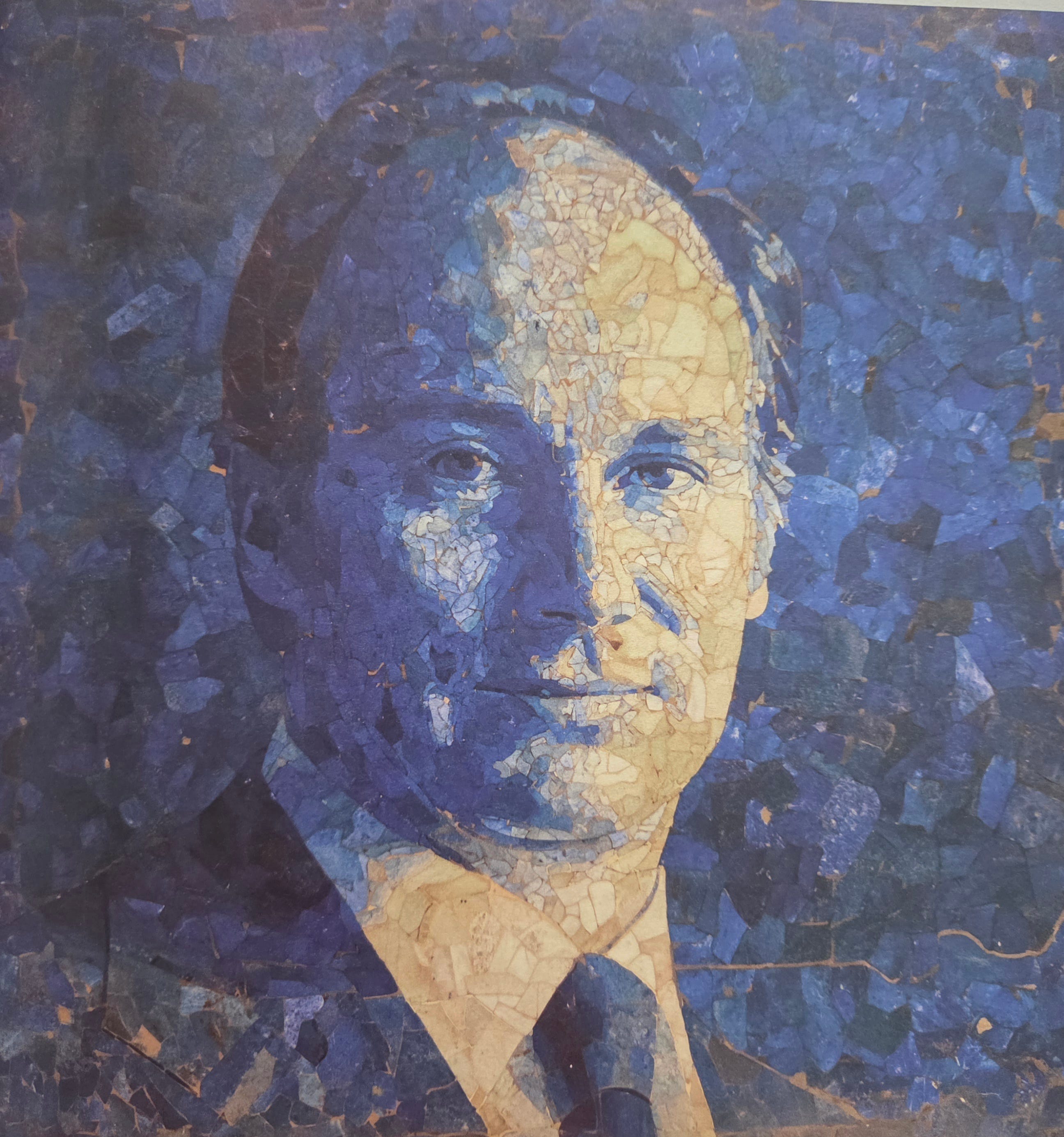
This portrait of Prince Karim Aga Khan was one of Guljee'S most iconic portraits